[OCP in Focus] Arm Targets $300B CPU Market by 2030 as Agentic AI Redefines Data Center Architectures
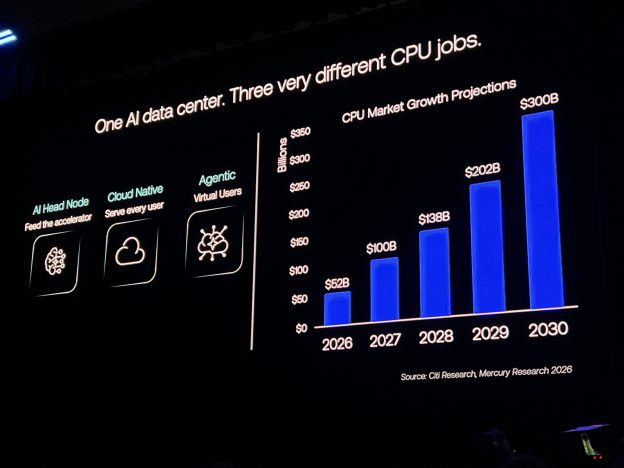
As agentic AI puts CPUs back in the spotlight, Arm is sharpening its focus on the emerging opportunity. Following the March debut of its Arm AGI CPU, designed for agentic AI workloads, the company shared its outlook on evolving market demand at the OCP Global Summit 2026.
Here are the key takeaways from Mohamed Awad, Arm’s EVP and General Manager of the Cloud AI Business Unit, and Ravi Malhotra, Director of Solutions Product Management, as reported by TrendForce on-site.
3 Specialized CPU Roles in AI Data Centers
Awad elaborated on how the CPU is critical and highly optimized for specific roles in modern AI infrastructure, including AI Head Node, Cloud-Native CPUs, and Agentic CPUs.
“The head node is all about co-design. Its primary responsibility is to keep the accelerator from sitting idle. Now we all know that the accelerator and memory are an expensive depreciating asset, and we don’t want it to sit idle. So the head node has been optimized to keep that accelerator productive as much of the time as possible. It’s responsible for scheduling, for moving data, for managing memory,” he said.
Then here comes Cloud Native CPUs, with custom tailored CPUs having been quietly transforming all aspects of the data center. According to Awad, high core count custom CPUs enable VMs that perform and are efficient and scale. And custom built DPUs are designed to support that networking, that storage, that security, that control plane.
Lastly, Agentic AI is rapidly becoming the AI workload. “An agent is just a virtual user. A virtual user who never sleeps, Awad said, adding that “That means dedicated CPUs, dedicated memory, dedicated resources… It means the CPU is more important than ever. That’s why CPU demand is going through the roof.”
Against this backdrop, Arm, citing research projections, notes that the CPU market is expected to surge from $52B in 2026 to $300B by 2030.
Dual-Track Infrastructure: Pairing AI Racks with CPU Racks
Malhotra highlighted that the infrastructure for agentic AI fundamentally consists of two complementary parts.
“On one side, you have got AI racks or AI infrastructure, which is focused on agentic reasoning and planning,” he explained. In this domain, the primary goal is running various types of models to deliver high token throughput—maximizing tokens per second, per watt, and per dollar.
“On the other hand, you’ve got CPU racks. All of the agentic tooling and orchestration is typically going to run on these CPU racks,” Malhotra noted. As a result, whenever enterprise customers deploy agentic infrastructure, their decision-making naturally revolves around evaluating what their AI infrastructure looks like and how to effectively pair it with the corresponding CPU racks.
AGI CPU in Focus
To address the demand spurred by agentic AI, Malhotra highlighted the breakthrough of Arm’s AGI CPU, the first server-grade CPU silicon designed by the company.
“Now when we’re designing AGI CPU, we kept three things in mind: high performance, scalability, and efficiency, and we made some deliberate design choices. We took the latest third generation Neoverse core, where we worked on a lot of optimizations in partnerships with hyperscalers. We focus on reducing the memory latency, ensuring that there’s high memory bandwidth per core so that there’s no contention, and at the same time, we are ensuring that there’s linear scalability—there’s no drop in performance, you can use it at 90, 95% utilization. And finally, you can do all of this at a power envelope which allows you to reduce your cooling costs as well as pack in more number of cores at the rack level,” Malhotra emphasized.
(Photo credit: TrendForce)