[News] Beyond CXMT’s 89.53% Gross Margin in 3Q26: 3 Key Takeaways on LTAs, 4F² Advancement and LPDDR6
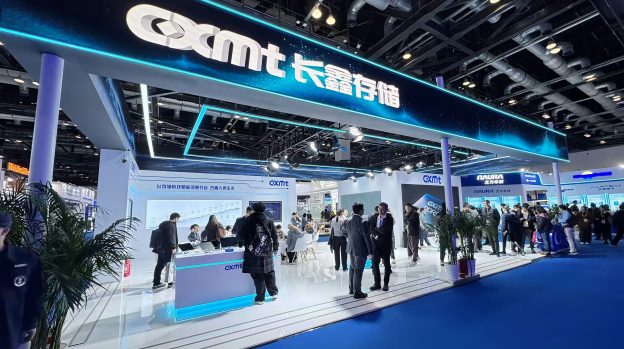
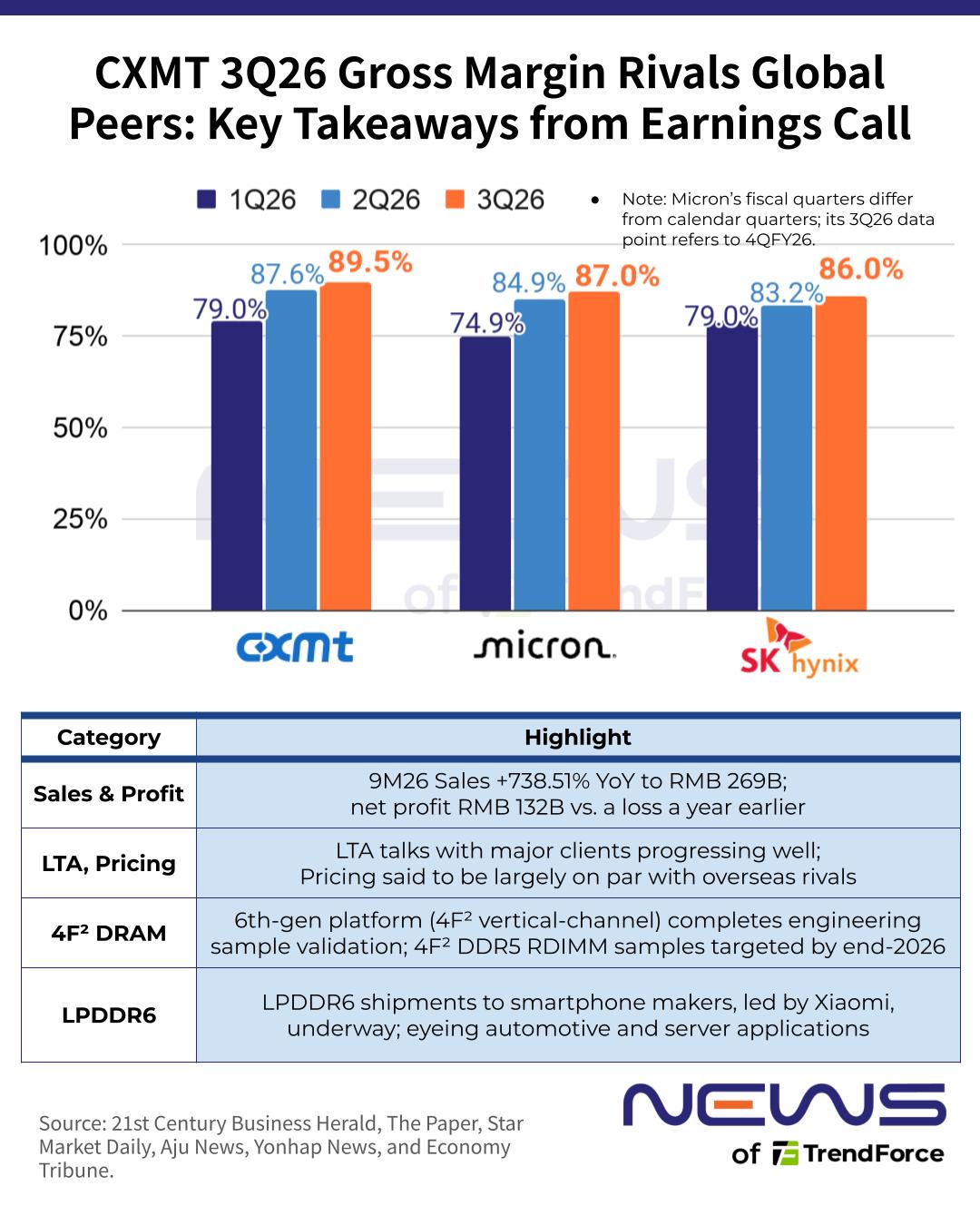
Following record earnings from South Korean memory giants, China’s CXMT has also delivered standout results alongside key business updates. As reported by 21st Century Business Herald, CXMT’s third-quarter gross margin rose 1.94 percentage points QoQ to 89.53%. In comparison, Micron reported a gross margin of 87% for the quarter ended September 3, 2026, while Samsung posted a consolidated gross margin of 69.3% in 3Q26.
Meanwhile, as reported by The Paper, CXMT’s revenue surged 738.51% YoY to CNY 269.02 billion in the first nine months of 2026, while net profit swung to CNY 132.04 billion from a year-earlier loss.
But beyond the earnings boom, what comes next for CXMT? Here are three key takeaways from its earnings call: long-term supply agreements, 4F² progress, and LPDDR6 expansion plans.
CXMT Eyes LTAs, Pricing on Par with Rivals
With Samsung securing long-term supply agreements (LTAs) with 10 customers and SK hynix with 14, CXMT is also stepping up its efforts. According to 21st Century Business Herald, the company’s LTA negotiations with several major clients were progressing well, aiming to secure medium- to long-term demand.
On pricing, CXMT stressed that its products are generally priced on par with those of overseas rivals, according to Star Market Daily. Meanwhile, the company expects its gross margin to remain stable in 4Q26.
CXMT’s pricing claims echo an August report by South Korea’s Aju News, which noted that some of its products were already priced on par with South Korean rivals, with the report also highlighting that Apple was reportedly testing CXMT’s memory for iPhones and MacBooks.
However, Yonhap News adds that consumer electronics still account for 30–40% of global memory demand, with buyers’ resistance to price hikes potentially slowing CXMT’s earnings growth over the coming quarters.
CXMT’s 4F² DRAM Clears Key Validation Milestone
Meanwhile, according to The Paper, CXMT announced that its sixth-generation process platform, based on 4F² vertical-channel DRAM architecture, had completed engineering sample validation. The milestone reportedly indicates that key performance targets have been met on actual wafers, bringing the technology closer to volume production.
The progress also brings CXMT closer to its goal of sampling 4F²-based DDR5 RDIMMs for servers by the end of 2026. While CXMT had previously discussed its 4F² advances at academic forums, the latest development marks its first public confirmation that the sixth-generation platform uses the architecture, The Paper reports.
Memory makers, however, are taking different approaches. While Micron has ruled out 4F² from its roadmap, SK hynix is pursuing both 4F² vertical-gate (VG) technology and 3D DRAM. Samsung is also in the race, having presented 10nm-class 4F² research at ISSCC 2026, with its CTO reaffirming development efforts in October, The Paper reports.
Servers, Autos for Next-wave LPDDR6 Expansion
With LPDDR6 shipments to smartphone makers, led by Xiaomi, already underway, CXMT is setting its sights on automotive and server applications.
For server-grade potential applications, Economy Tribune highlights that the first could be CPU system memory, as NVIDIA adopts LPDDR5X for its Vera CPU and AMD plans to support LPDDR5X-based SOCAMM2 in its next-generation EPYC processors. However, despite the development of LPDDR-equipped PC processors in China, adoption among major domestic server CPU makers, including Huawei, remains unconfirmed, the report notes.
The second potential application, the report notes, could be memory for AI inference GPUs. Earlier this year, Chinese GPU developer Sunrise unveiled a design for its Qiwang S3 inference GPU that uses LPDDR6 instead of HBM, aiming to improve memory capacity, power efficiency, and cost competitiveness, the report notes.
In short, CXMT’s strong 3Q26 results have been mainly built on tight supply and rising prices. The next test is whether it can sustain that momentum through new product launch, LTA conversion and a possible softening in consumer demand.
Read more
- [News] CXMT Reportedly Ships HBM3E Samples, Eyes Production Within 2 Months Despite 20–30% Yields
- [News] CXMT Accelerates 4F² DRAM Push, Eyes Year-End Server DDR5 RDIMM Launch
(Photo credit: CXMT)